CAN THE MACHINE HELP US?
Hungry Talks’ first episode of 2026, Can The Machine Help Us?, explores our number one insecurity in the comms industry: is AI taking our jobs? We invited three guests, plus my own segment, to unpack the realities of AI in a world where we shout, ‘For The Love Of Humans!’
-
Hungry Talks’ first episode will be live-to-air, and needs to establish the annual theme, ‘For The Love Of Humans’, while addressing AI concerns. The writing required:
A scripted intro and outro, including research and engaging copy
Questions for the main discussion
Questions and filler content for a game segment
A recap blog for LinkedIn
Promotional material for LinkedIn
-
I wrote and edited the full 50 minute episode, with input from the CD and ACD, while leading the LinkedIn Campaign.
Took an investigative, yet empathetic approach to the issue of AI in communications - supported by research and guest input
Adjusted scripting to suit the hosts’ on-screen personalities
Created engaging short-form videos to promote and clip the episode
Hosted my own segment, Future Forecast, with professional and anecdotal insights
-
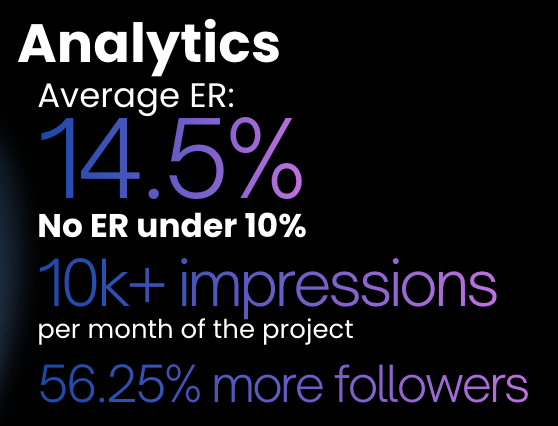
Reached 300+ episode views
Improved to a 14.5 minute audience retention
Achieved hundreds of views, on live and catch-up
LinkedIn recap article achieved a 11% ER and 8% CTR
ICYMI: Episode 1 Recap
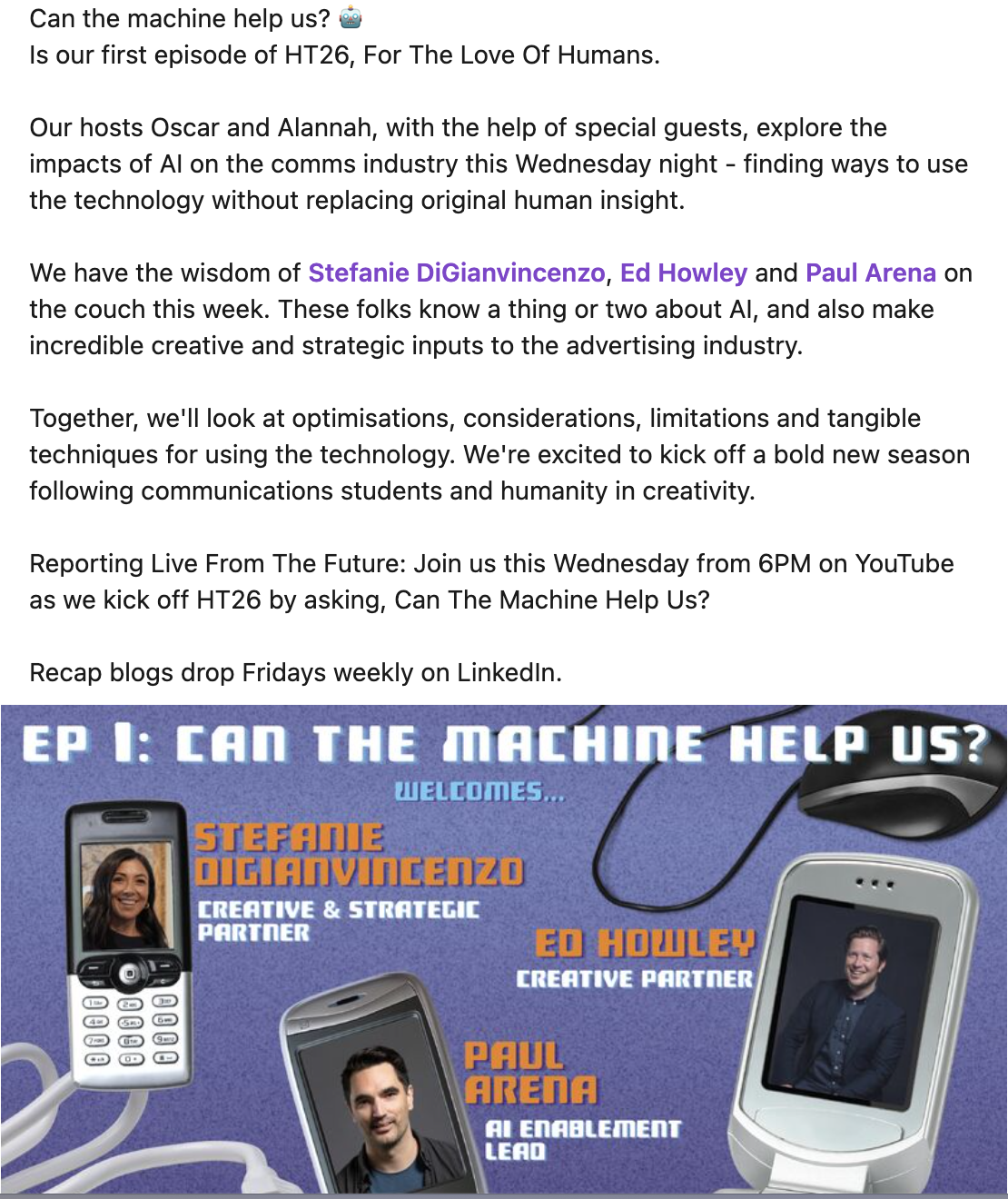
LinkedIn Promo
Wait… what even is Hungry Talks?
Can The Machine Help Us? Our Guests Say Humans Win.
Gen Zs entering the workforce are the first generation of digital natives. We’ve had the internet our whole lives, yet entry-level roles feel out of reach when we’re racing against the machine.
Hungry Talks For The Love Of Humans tackles that head-on; the future of communications, wrangling the machine with all that makes us human.
Episode 1 asked, Can The Machine Help Us? Our answer is yes, with caveats. Let’s unpack it.
Meet the Guests
Our first episode welcomed Stef DiGianvincenzo, Ed Howley and Paul Arena to offer HI (Human Intelligence).
DiGianvincenzo is a Chief Marketing Officer with experience in Meta, Google, and Ovum AI. A creative strategy pro who helps us to understand the real world of digital marketing and AI integration.
Howley is a Founding Creative Partner of By All Means who’s been included in B&T’s 30 under 30 and Campaign Brief’s Small Agency of the Year list. It’s an exciting time to get this ideas man on the show.
Arena is a brand, strategy and marketing whiz - and most recently, an AI Enablement Lead at Clemenger BBDO. An Effie and Cannes Lions winner who’s worked with some of the biggest brands in Australia.
Hosts Oscar and Lucia ran the discussion with questions like,
“How do you find a balance between AI criticisms and the way you use AI?”
“What is the smartest way you’ve seen AI being used?”
“Will humans outlast the machine, or is AI here to stay?” (more or less… Oscar ad-libbed about The Terminator).
‘Made Up’ Jobs in AI
Arena opened with his job title, AI Enablement Lead.
“If that sounds like a made-up job title, it’s because it was.”
He argues that the role is really a Human Enablement Lead, as he supports people using AI tools.
It’s the first example of ways AI is creating new opportunities. As Howley and DiGianvincenzo explain, these are not only for industry vets.
DiGianvincenzo notes that AI can be an invaluable tool for small businesses, letting them replace major software like Salesforce with AI agents. She also promotes the tech for juniors.
“There are absolutely opportunities for [young people] in AI.”
“Start experimenting, start making stuff,” added Howley. “Young people can upskill and learn [AI] tools.
What ‘Intelligence’ in Artificial Intelligence looks like
A commenter on our livestream contributed to the discussion - “Smart uses of AI is an oxymoron.” We struck a balance.
Arena leads the discussion around the ‘smartest’ AI uses - especially for building memory, context and understanding. AI can make systems to store knowledge and solve problems quicker, making it a useful tool to optimise workflows.
Human insight is still the driver of successful AI integration. As Howley puts it:
“The smartest use of AI is being disciplined in how we use it, and when and how. I think increasingly, [learning] how to employ AI in a way that elevates the human product is going to be the smartest use."
Limits of the Machine
The discussion moved to AI limitations. It’s used throughout creative processes in the industry, but often falls flat in its creative outputs.
AI is “really good at mediocrity,” says DiGianvincenzo. “If I see an AI ad on TV, I recoil from the screen. Right now, [AI executions] are brand damaging.”
On Ethics
So, what about AI reservations? Our hosts were quick to bring up environmental and ethical considerations - like energy use, ownership, and copyright.
“It’s Indefensible that a company could steal people's original thoughts and ideas, and not pay them a cent,” says Arena, who also advocates for more transparency in the AI sector.
The panel also raised the topic of AI brains - systems designed to replicate human thinking patterns and make complex connections between information. Organisations can create and store employee brain systems, even after an employee departs.
“What about my IP?” exclaims DiGianvincenzo.
Ending with Optimism
We end the episode with hope - especially around the value of diverse thinkers, human input and creative insight.
Our hosts wrapped up with their own thoughts on AI’s limits.
“AI does not understand Australia one bit. It never could’ve written Kath and Kim or The Castle. It’s different, it’s unusual, it's the vibe of the thing.”
“Campaigns like Bankwest’s unsettling ads or Kia’s zombie-proof campaign exist because people are willing to take risks and embrace the left-of-centre thought. This season celebrates that uniquely human creativity and the imperfections that make it so powerful.”
“I like to think the humans win,” says Howley.
We agree.
HT26 maintains that the best ideas have, and will continue to come from humans. AI is only as good as the ideas we give it. Our human insight will always set us apart.
Hungry Talks will continue to cry out, ‘for the love of humans!’